
Homeowners will spend weeks agonizing over a color and then choose a finish in about four seconds at the counter. It’s an understandable habit, but it’s backwards. The sheen has just as much say over how a room looks and holds up as the color does.
Interior paint finishes control how much light a surface bounces back, how easily it wipes clean, and how kindly it treats a wall’s flaws. Two rooms painted the exact same color can feel like different spaces depending on whether the walls are flat or glossy — and one of them might be far easier to live with a year later. It’s one of the quieter decisions in any interior house painting project, and one of the most consequential.
Getting it right is mostly a matter of understanding the spectrum, then matching it to how a room actually gets used.
The Sheen Spectrum, From Flat to Glossy
Every interior paint finish sits somewhere on a scale from no shine to high shine, and where it lands drives almost everything else about how it behaves. From least reflective to most:
- Flat (matte) — almost no shine, the softest look, and the best at hiding flaws, but the hardest to scrub.
- Eggshell — a low, subtle glow with a gentle step up in durability and washability.
- Satin — a soft sheen that cleans well and shrugs off daily life; the popular all-purpose choice.
- Semi-gloss — noticeably shiny, moisture-resistant, and easy to wipe down.
- Gloss — the highest shine and the toughest surface, saved for the hardest-working details.
As you move up that scale, durability and washability climb together while the ability to disguise imperfections falls away just as steadily. Almost every finish decision comes back to that single trade-off.
Why More Shine Means Less Forgiveness
The single most useful thing to understand about finishes is the trade-off built into that spectrum.
Shine reveals texture. The glossier a finish, the more it catches raking light and throws every ripple, seam, roller mark, and old patch into sharp relief. That’s why the best paint finish to hide imperfections is almost always the flattest one available — a matte surface scatters light in every direction instead of reflecting it back, so an older wall with a few dents and past repairs reads as smooth and even.
The cost of that forgiveness is washability. Flat paint holds onto scuffs and resists scrubbing, so the same quality that hides a wall’s history also makes it harder to clean. Nearly every finish decision is some version of this same tug-of-war between a flawless look and a durable one.
Matching the Finish to How a Room Is Used
Because sheen governs both cleanability and durability, the right finish depends far more on how a room lives than on taste alone.
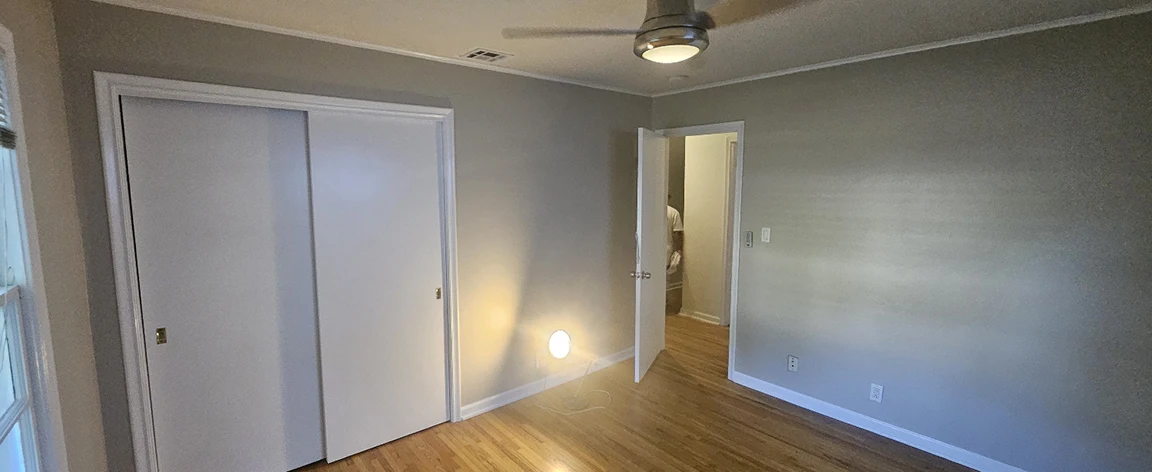
Bedrooms, formal sitting rooms, and ceilings see very little abuse, which is why the best paint finish for bedrooms tends to sit toward the flat end of the scale. A low sheen feels calm and restful, softens the light, and quietly hides the small imperfections most walls have collected over the years. There’s rarely a reason to reach for shine in a room that’s mostly for rest.
Wet rooms flip that logic completely. The best paint finish for bathrooms has to stand up to steam, splashes, and frequent wiping, so it belongs at the shinier end — satin at a minimum, and often semi-gloss on walls that take real moisture. The same reasoning carries into kitchens, where grease and fingerprints make a wipeable surface worth far more than a soft look.
Then there are the spaces that simply take a beating. Choosing the best paint finish for high-traffic areas — hallways, entryways, stairwells, mudrooms — is about survival more than style. Hands, shoulders, shoes, pets, and hauled-in furniture all leave their mark, so these zones call for something scrubbable like satin that can be cleaned again and again without wearing through.
Flat vs. Eggshell: The Everyday Wall Decision
For ordinary walls in ordinary rooms, the flat vs. eggshell paint question is the one homeowners wrestle with most.
Both live at the soft end of the spectrum, so the choice comes down to how much washability you’re willing to trade for a flawless look. Flat wins on hiding flaws and gives walls a rich, velvety depth, which makes it a favorite on ceilings and in rooms that stay calm and clean. Eggshell gives up a little of that camouflage for a surface you can actually wipe down, which is why it’s become the safe middle ground for living rooms and bedrooms that still need to tolerate real life.
Satin vs. Semi-Gloss: Trim, Doors, and Wet Rooms
A step up the scale, the satin vs. semi-gloss paint decision usually sorts itself out by surface.
Satin is the workhorse for walls that need durability — hallways, kids’ rooms, kitchens — because it cleans easily without drawing attention to itself. Semi-gloss goes where you want both moisture resistance and a crisp, defined look: trim, doors, cabinetry, and bathroom walls that fight humidity. The brighter a finish, the more it accentuates the shape of what it covers, which is exactly why trim in semi-gloss looks sharp while the same sheen across a large wall can feel harsh and unforgiving.
The Finishes That Get Decided for You
A few surfaces have a conventional finish for good reason, and it’s usually wise to follow the convention.
Trim, baseboards, and doors are almost always painted in semi-gloss or gloss, because those surfaces get touched constantly and benefit from both the durability and the definition that shine provides. Ceilings run the opposite direction, nearly always flat, since any sheen overhead magnifies every imperfection and telegraphs the seams. Knowing where the room’s use makes the decision for you is half the battle — the rest is applying the same logic to the walls in between.
Getting the Finish Right the First Time
A finish either disappears quietly into a room or starts showing its age within months, and the difference comes down to matching the right sheen to how each surface is actually used.
That judgment is the kind of thing that gets sharper with every home. We help homeowners across the entire Tulsa metropolitan area make these calls all the time, from the flattest ceiling to the glossiest door, and we’re happy to walk your rooms with you and recommend finishes that will look right and hold up for years. Based in Broken Arrow, fully insured, and standing behind our work with a two-year workmanship warranty, we treat the finish with the same care as the color. When you’re ready, reach out for a free estimate and we’ll take it from there.